Compare
Virtual assistant or employee: what each costs
An employee costs more than their salary: employer National Insurance, pension, holiday, equipment, recruitment and management time all add to it. A virtual assistant is priced as an hourly rate for a set number of hours a month, 160 full time or 80 part time, with recruitment, payroll and management included. This page works the sums from published UK figures and shows every assumption, so you can swap in your own. Also compare virtual assistant vs freelancer.

Side by side
The differences at a glance
| Virtual assistant | Employee | |
|---|---|---|
| Recruitment | We run it. No separate recruitment fee | Your time, or an agency fee |
| Payroll and management | Included in the price | You run payroll and manage the employment |
| Employer costs | Not stated in this comparison | National Insurance, pension, holiday, equipment |
| Where they work | Remotely, in your tools | In your office, or remotely if you agree |
| If it is not working | One week's notice in the first 3 months, then 1 month. A replacement in the first days, included in the ongoing fee while you pay | Set by the employment contract and the law. A replacement is your time, or another recruitment fee |
Which one
Which is right for you?
Choose an employee if
You need someone on site, or a long term core member of the team who will grow into a senior role in your office.
Choose a virtual assistant if
The work can be done remotely and you want a set number of hours a month. A full time virtual assistant is 160 hours a month.
The sums
The sums, from published figures
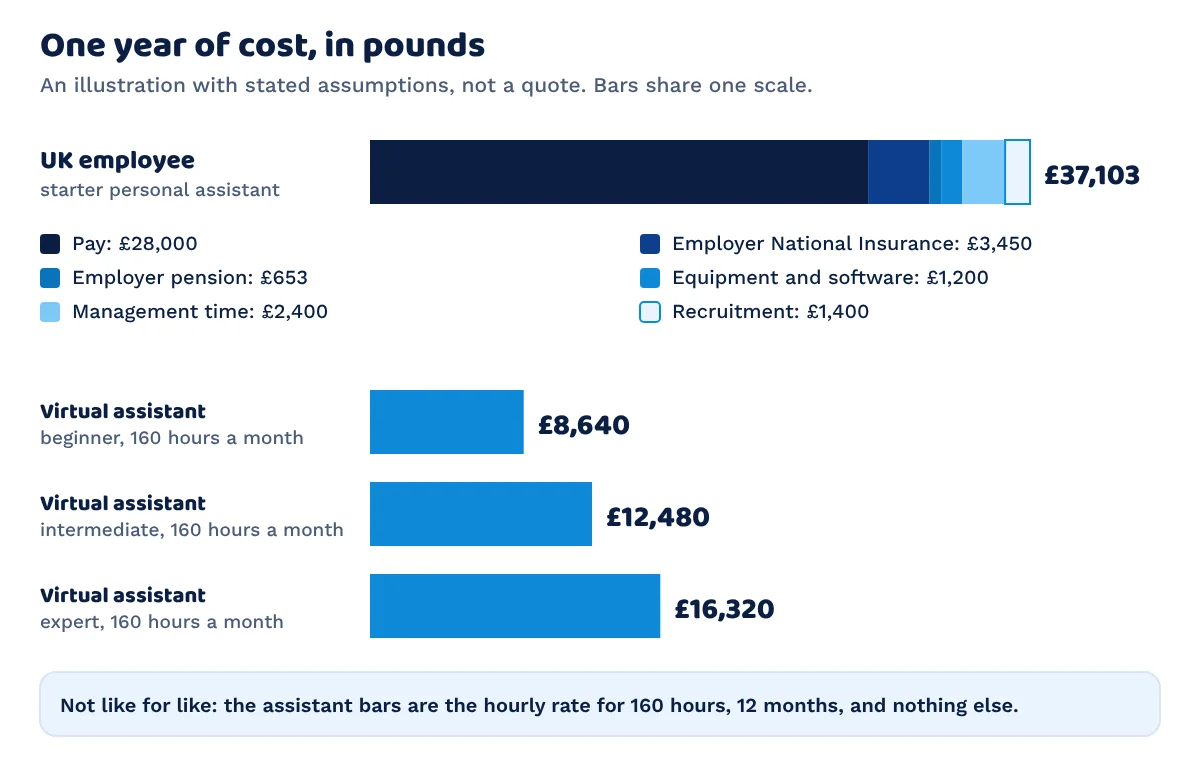
This is an illustration, not a quote and not a promise of any saving. The example is a personal assistant at the starter end of the range. All figures are in pounds.
UK sources
- Salary: £28,000 a year is the starter salary for a personal assistant on the National Careers Service job profile, read on 8 November 2026 (undated page; experienced salary on the same page is £60,000) (source: National Careers Service).
- Employer National Insurance: 15 percent of pay above £5,000 a year (source: GOV.UK, rates and thresholds for employers 2026 to 2027, updated 1 September 2026).
- Employer pension: 3 percent minimum on earnings between £6,240 and £50,270 (source: GOV.UK, workplace pensions).
- Holiday: 5.6 weeks, 28 days, for a five day week (source: GOV.UK, holiday entitlement).
Our assumptions (not sourced; change them)
- Equipment and software £1,200 a year. Estimate: an assumption.
- Recruitment £1,400 a year. Estimate: an assumed agency fee of 15 percent of salary, spread over a three year stay, which is 5 percent a year.
- Management time 2 hours a week for 48 weeks at £25 an hour, £2,400 a year. Estimate: an assumption.
| Cost for one year | UK employee, starter personal assistant | Virtual assistant, 160 hours a month |
|---|---|---|
| Pay | £28,000 | Hourly rate × 160 × 12 |
| Employer National Insurance | £3,450 | Not stated in this comparison |
| Employer pension | £653 | |
| Equipment and software | £1,200 | |
| Management time | £2,400 | |
| Recruitment | £1,400 | No separate recruitment fee |
| Payroll management | Not costed here | Included in the price |
| Total | £37,103 | £8,640 beginner, £12,480 intermediate, £16,320 expert |
The assistant figure is the hourly rate for 160 hours only. The employee figure includes costs that are not costed for the assistant, so the two totals are not like for like.

Our figures use the personal assistant base rate of £4.50 an hour, with intermediate at 1.4 times and expert at 1.9 times, each rounded to the nearest 50p (see pricing).
What this leaves out. The match between a job profile and an experience level is rough. The employee’s 28 days of paid holiday leaves about 1,856 working hours from a 40 hour week: 52 weeks at 40 hours is 2,080 hours, less 28 days of 8 hours, which is 224. Our figures use 1,920 paid hours (160 hours for 12 months). The assistant column shows the hourly rate only. We do not state a leave arrangement for our assistants here. You manage the assistant’s work day to day, as you would an employee’s. An employee can be in your office and a remote assistant cannot.
The pricing page shows the monthly cost of every role and level. This page works the sums for one employee role. The cost calculator compares the full cost of a UK employee with a virtual assistant.
Free tool
Run your own numbers
Questions
What does an employee cost?
An employee costs salary plus employer National Insurance (15 percent above £5,000 a year), a minimum employer pension of 3 percent on qualifying earnings, paid holiday, equipment, recruitment and management time. On a £28,000 salary, the sums above give about £37,103 for a year, with recruitment spread over three years and the other assumptions stated.

Is a virtual assistant cheaper than a UK employee?
It can be, depending on the role, the experience level and what you count in the employee’s cost. The sums on this page compare a starter personal assistant with a virtual assistant at three experience levels, with every assumption shown. See pricing for other roles. If you need someone on site, an employee is the better fit.
Is hiring a virtual assistant worth it?
It is worth it when the work can be done remotely, you can describe the tasks clearly and you want a set number of hours each month. It is less suited to work that needs someone in your office. The cost calculator compares the full cost of a UK employee with a virtual assistant.
Work out the employee side of this comparison with your own figures in the UK employer cost calculator.
Get started
Prefer to write? Send an enquiry.
Tell us the role and the hours you have in mind, and we will reply to the email address you give.